.png)
Is Vaginismus Just a Tight Pelvic Floor Problem?

I got a call from a woman who wanted to come in for pelvic floor PT for Vaginismus. She told me her pelvic floor felt tight and she couldn’t figure out how to get it to relax. Her main goals were to have a gynecological exam without pain and to have pain-free sex.
But is this really just a pelvic floor tension issue?
Not necessarily.
Before I get into the why behind that (possibly unexpected) answer, let’s define vaginismus according to medical literature:
Vaginismus is defined as a condition involving recurrent or persistent involuntary contraction (spasm) of the pelvic floor muscles surrounding the vaginal opening, which interferes with vaginal penetration and may cause pain or distress.
Muscle contractions can be voluntary and/or involuntary.
I can close my eyes (voluntary) or get an eye twitch (involuntary).
I can push off through my foot when walking (voluntary) or get a calf cramp (involuntary).
I can chew my food (voluntary)… or catch myself clenching my jaw during a stressful moment (also involuntary).
The contraction or spasm of the pelvic floor with vaginismus would be much easier to release if it were voluntary—you could simply “stop tightening” or stop kegeling. But that’s not what’s happening here.
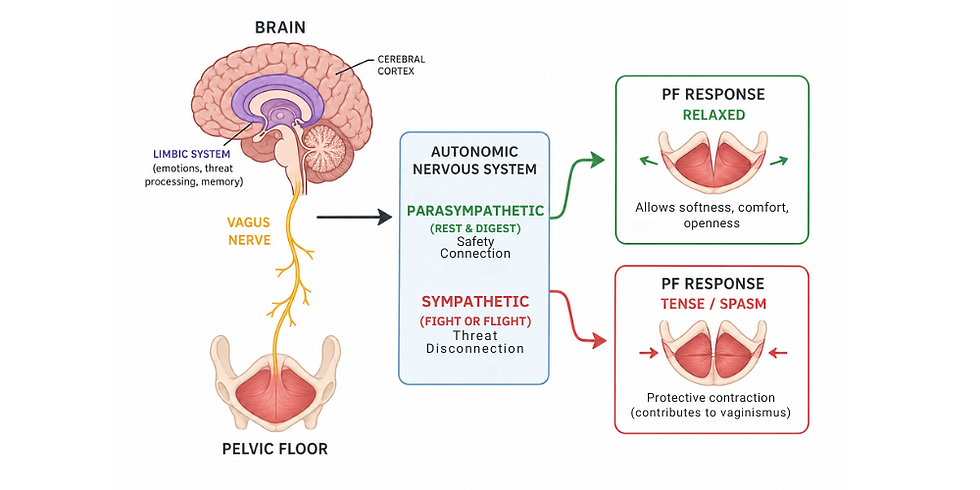
This muscle activation is involuntary, meaning it’s driven by the part of your body working behind the scenes to keep you safe and alive: your nervous system.
More specifically, your autonomic nervous system—the system that regulates things like heart rate, breathing, digestion, and muscle tone without you having to think about it.
It has two main branches:
The sympathetic nervous system (your “fight or flight” response)
The parasympathetic nervous system (your “rest, digest, and restore” state)
When your body perceives a threat—whether that’s physical, emotional, or even anticipated—the sympathetic system can take the lead. One of the ways it responds is by creating protective strength, that shows up as tension patterns in the body… including the pelvic floor.
This is where the mind–body connection becomes really important.
The limbic system, the part of your brain involved in emotions, memory, and learned experiences, helps shape how your body interprets situations. If penetration has been painful, uncomfortable, or even just associated with fear or uncertainty, your brain can start to anticipate that experience.
And your body responds accordingly.
The vagus nerve, which connects your brain to many of your organs, plays a key role in regulating this response. When things feel safe, it supports relaxation and openness. When something feels unsafe—even subconsciously—the body may shift into a more protective state.
So while the autonomic nervous system is what’s carrying out the response (tightening, guarding, relaxing), it’s constantly being influenced by what your brain is perceiving and what your body has learned.
And here’s the important part: those patterns aren’t permanent.
Your brain and nervous system are adaptable. This is known as neuroplasticity—your body’s ability to learn, unlearn, and rewire patterns over time.
Just like your body learned to associate certain experiences with needing strength (and giving tension) or protection, it can also learn something different.
With the right support and repeated experiences that feel safe, your system can begin to shift. The same pathways that once led to guarding can begin to allow relaxation.
Not by forcing it… but by teaching your body that it’s safe to respond differently.
That said, sometimes these systems can get stuck in a more protective state.
If you’ve experienced trauma, these systems may be on higher alert—working harder behind the scenes for your survival, even when it’s not necessary anymore. Even if you’re currently in a safe, loving relationship… or even feeling safe with yourself at times.
And it’s important to say—not everyone who experiences vaginismus has a history of sexual or non-sexual trauma.
We all grow up with different experiences, messages, and stories—things we were told, things we observed, and things our bodies learned along the way.
It could be:
A painful UTI
Constipation as a kid
A difficult first pelvic exam
Hearing that sex is “bad,” “dirty,” or something to fear
Your body takes in those experiences and, in an effort to protect you, may respond with tension.
And while that response may have once been helpful… it’s not necessarily helpful now. In fact, it can start to work against you.
The way I often explain it is that there’s a bit of a glitch in how the mind and body are communicating. The threat is no longer there, but the body is still responding as if it is.
So yes—sometimes the pelvic floor is tight, especially if there has been persistent muscle contraction over time. And other times, the muscles may only tighten in response to anticipation or attempted penetration.
That’s why simply telling someone to “just relax” or “do kegels” completely misses the mark.
What’s actually needed is helping the body relearn safety.
Gradually, gently, and without force—allowing the nervous system to become familiar with both the idea and the experience of penetration in a way that feels safe and supported.
And I want to be really clear about this:
It’s not “all in your head.” But it is connected to your brain and nervous system.
Sometimes the mind is still signaling danger, and the muscles respond by tightening to protect you. Other times, the muscles themselves have adapted to being in a more guarded state after prolonged tension.
Both can be true. And both are treatable.
What Actually Helps
So if vaginismus isn’t just a tight pelvic floor problem… what does treatment actually look like?
It involves supporting both the body and the nervous system.
This might include:
Pelvic floor physical therapy to improve awareness, coordination, and reduce unnecessary tension
Breath work to support nervous system regulation
Gentle, progressive exposure to penetration (at your pace)
Education so you understand what your body is doing—and why
Techniques that help your body shift out of protection mode and into a state of safety
Because the goal isn’t to force the muscles to relax.
The goal is to help your body feel safe enough that it no longer needs to guard.
If This Sounds Like You
If you’ve been dealing with pain, avoidance, or frustration around penetration—you’re not alone. And this is something that can absolutely improve with the right support.
You don’t have to keep guessing. You don’t have to push through pain.
There’s a different way to approach this—one that works with your body, not against it.
If you’re ready to explore that, I’d love to support you.


Comments